


The Kris Jenner Phenomenon on RedNote: When Memes Become Economic Signals
How symbolic identity becomes a tool for signalling ambition in competitive and uncertain environments
A curious ritual has taken hold on RedNote, the Chinese social platform known as Xiaohongshu. Thousands of Gen Z users have replaced their profile pictures with Kris Jenner. What appears to be a passing joke reveals something more structured when viewed through the lens of culture, economics and identity formation.
Jenner is no longer simply a celebrity. She functions as a symbolic proxy for success. Variations such as “Lawyer Kris” or “CEO Kris” embed her image into projected professional identities. This is not fandom. This is signalling, where users attach themselves to a recognisable symbol of competence and upward mobility.
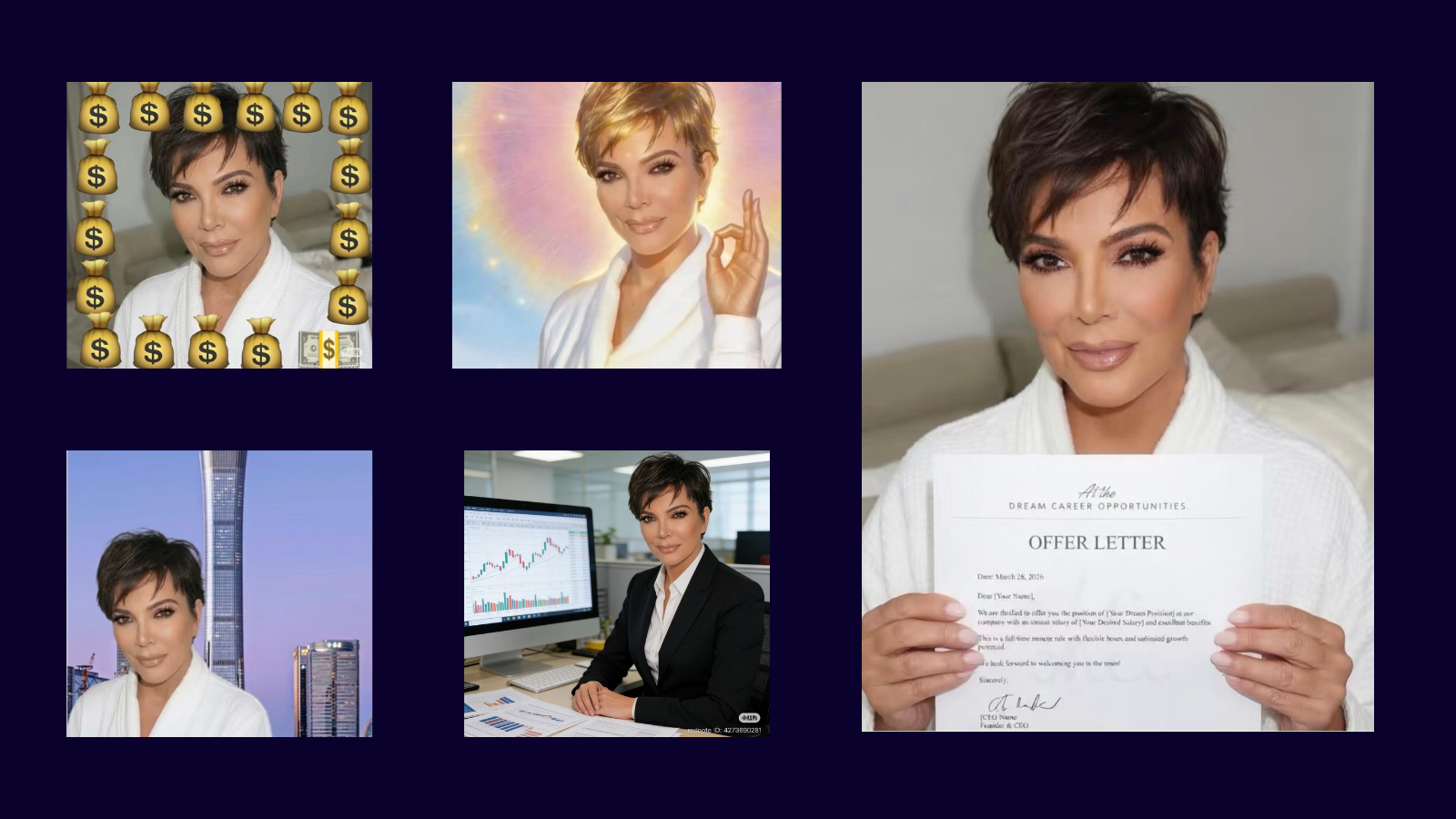
Gen Z are the first cohort to actively construct and manage their own reputation from an early age through social media, but within systems they do not fully control. In this context, adopting a figure like Jenner provides a ready-made framework for signalling ambition with clarity and consistency.
The behaviour aligns with classic signalling dynamics. When outcomes are uncertain and underlying qualities are difficult to observe, visible cues become more important. Cultural forms that compress complex ambition into simple, legible symbols are more likely to spread.
Jenner’s image generates clear contextual signals such as wealth, ambition and success, themes that strongly resonate with Chinese Gen Z. Because these signals are consistent and easily recognised, she becomes a strong symbol of them. That clarity is what allows her image to scale and become a cultural phenomenon.
Jenner’s significance is not accidental. She represents constructed success, where influence, control and outcome are deliberately engineered rather than inherited. That makes her a particularly effective symbol for signalling ambition in environments where progression feels uncertain.
This is not just virality. The phenomenon reflects how cultural signals operate under pressure. Efficiency and recognisability determine what travels.
From a sociological perspective, the behaviour extends beyond Goffman’s presentation of self. Users are not just managing perception. They are staging future versions of themselves. Identity shifts from representation to projection.
The profile picture becomes a declaration of trajectory. The signal allows individuals to indicate direction even when mobility is slow or uncertain.
This dynamic is inseparable from its economic context. Younger cohorts face intense competition, opaque career pathways and constrained upward mobility. In such conditions, symbolic acts take on greater importance because they offer a sense of agency even when outcomes cannot be fully controlled.
The Kris Jenner meme becomes a low-cost tool for navigating this system. Participation enables alignment with success narratives without requiring immediate proof. Users signal competence and ambition while insulating themselves from the gap between aspiration and reality.
Crucially, the meme does not require belief. Ambiguity allows the same act to function as humour, signalling and intent. The absence of commitment lowers the barrier to participation and enables scale.
The cross-cultural dimension amplifies significance. Jenner’s persona, rooted in entrepreneurial culture and ambition that resonated with Chinese audiences, is reinterpreted within a Chinese digital ecosystem through local archetypes of authority and prosperity. This is not passive consumption but active translation. Global symbols are adapted to local conditions shaped by similar structural pressures.
Memes act as reputational shortcuts. Reputation becomes partially anticipatory, shaped as much by what is convincingly signalled as by what has been achieved. In this sense, memes function as powerful assets. They are highly shareable, compress complex ideas into instantly recognisable forms and travel quickly across networks. Their effectiveness lies in the combination of low cognitive load and high informational density. What might otherwise require lengthy explanation can be conveyed through a single image, video or generative format. This balance makes them especially impactful, allowing audiences to process, remember and retransmit meaning with minimal effort while still absorbing a rich set of associations.
This points to a broader strategic shift. Impactful reputation-building no longer relies primarily on extended exposition. It depends on selecting formats that minimise cognitive effort while maximising signal clarity. Visual, interactive and AI-mediated formats increasingly outperform text in transmitting intent, especially in environments where attention is fragmented and speed determines reach.
Reputation is no longer linear or fully controlled. The system is co-created, remixed and redistributed across platforms, with symbols detached from their original context and reattached to new meanings at speed.
This condition has long been recognised by Michael Macfarlane Associates. Across the firm’s work, reputation is treated not as a static outcome but as a dynamic system shaped across multiple channels, formats and interpretations.
In this environment, strength lies in coherence rather than rigidity. Reputation must be designed to travel, retaining meaning as it is translated across formats and audiences.
The deeper shift is this: upward intent has become a reputational force. Individuals signal not just who they are, but where they are trying to go, using shared cultural assets that make ambition visible.
Reputation is no longer a fixed outcome. Reputation is an active, distributed process shaped as much by participation as by achievement.